


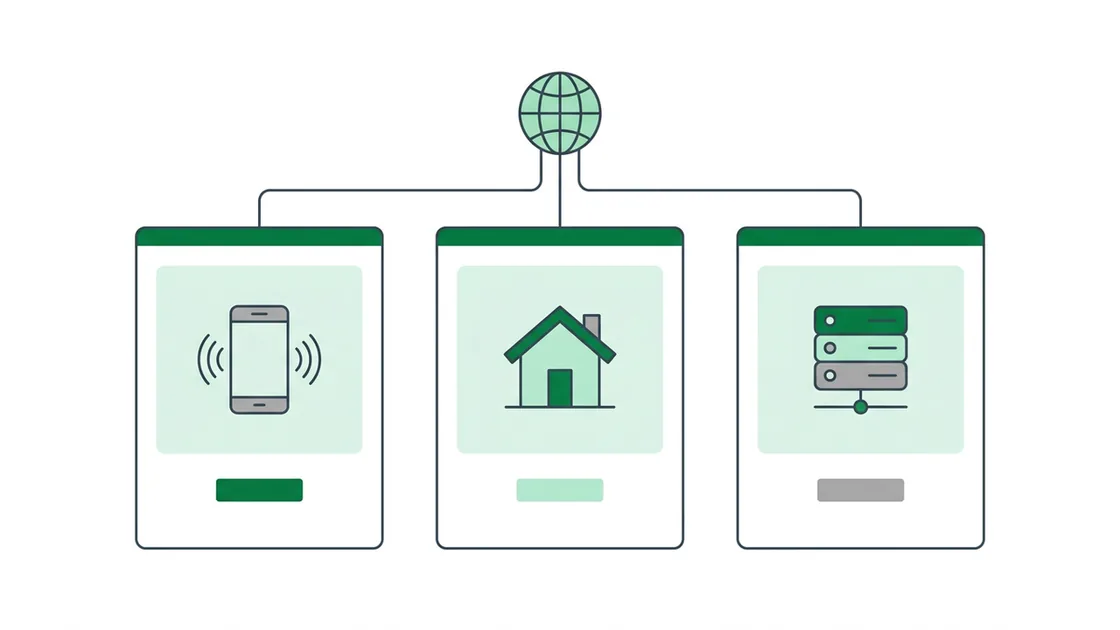
A proxy routes your traffic through an intermediary IP address so the destination site sees that IP instead of yours. The only meaningful difference between mobile, residential and datacenter proxies is the origin of that IP — and origin is exactly what anti-bot systems score. Mobile IPs are issued by phone carriers and shared by thousands of real subscribers behind CGNAT, which makes them the most trusted; residential IPs map to home ISPs; datacenter IPs resolve to hosting providers like AWS or OVH and carry the lowest reputation. Everything in the table below follows from that single fact.
Mobile vs residential vs datacenter: side by side
| Proxy type | IP source | Detection / ban resistance | Speed | Typical cost | Best for |
|---|---|---|---|---|---|
| Mobile (4G/LTE/5G) | Real phone carrier, physical SIM, via CGNAT | Highest — carrier IPs are shared by thousands of real users, so blanket bans are impractical | Moderate (depends on signal / 4G vs 5G) | Highest: from $27/mo dedicated, $10.80/mo shared | Account creation, social media multi-accounting, ad verification, AI agents — anything that must look like a real phone |
| Residential | Home ISP broadband (e.g. Comcast, BT) | High — but IPs are stickier per household and increasingly fingerprinted | Variable (peer-network latency) | Usually metered per GB, mid-to-high | Geo-restricted content, general scraping where a home IP suffices |
| Datacenter | Cloud / hosting provider (AWS, OVH, Hetzner) | Lowest — ASN flagged as hosting; often blocked on sight by mature anti-bot | Fastest, very high bandwidth | Cheapest, often a few dollars per IP | Bulk requests to lenient endpoints, internal tooling, speed-critical tasks on un-protected sites |
Proxy4G sells mobile proxies only. Datacenter and residential rows are for comparison.
What makes a mobile proxy the hardest to ban?
A mobile proxy sends your traffic out through a real handset holding a physical SIM on a real carrier — at Proxy4G that's networks like AT&T, T-Mobile and Verizon in the US, Free Mobile, SFR and Orange in France, or Jio 5G in India. Because carriers conserve scarce IPv4 space, they place tens of thousands of subscribers behind a single public IP using Carrier-Grade NAT (RFC 6598). To a website, your request is indistinguishable from any normal phone on that network.
That shared pool is the whole advantage: if a site bans the IP, it also bans the legitimate phone users behind it, so platforms keep mobile ranges on a long leash. The result is the 100% trust score that mobile IPs carry on services like IPQualityScore. For deeper mechanics, see what is a mobile proxy and how mobile proxies work.
When does a residential proxy make sense?
Residential proxies route through real home-broadband connections — IPs that belong to consumer ISPs rather than carriers or clouds. They sit a notch below mobile on trust because a household IP is more static and more uniquely tied to one location, which makes it easier to fingerprint and reputation-score over time. They are typically billed per gigabyte, so heavy crawling can get expensive fast.
They're a reasonable fit for unblocking geo-restricted content or scraping sites that only need to see a non-datacenter IP. But for the hardest targets — Instagram, TikTok, sneaker drops, ad-platform verification — the mobile signal still wins, because anti-bot engines explicitly weight carrier ASNs more leniently than residential ones. See rotating vs dedicated proxies for the rotation angle, which applies to both.
When is a datacenter proxy the right tool?
Datacenter proxies come from servers in hosting facilities. They are fast, cheap and offer enormous bandwidth, which makes them excellent for high-volume requests to endpoints that don't run serious anti-bot defenses — internal tooling, public APIs, price feeds, or speed-critical scraping of lenient sites.
Their weakness is reputation. Every datacenter IP resolves to a hosting ASN (AWS, OVH, Hetzner, DigitalOcean), and mature platforms maintain block-lists of those ranges, often refusing the connection on sight. For account creation, social platforms, ticketing or ad verification, a datacenter IP is usually a dead end. If your target shows CAPTCHAs, soft-bans, or 'unusual traffic' warnings, that's the signal to move up to mobile. Compare the economics in flat-rate vs pay-per-GB proxies.
Which proxy type should I use for my use case?
| Use case | Recommended type | Why |
|---|---|---|
| Social media multi-accounting | Mobile | Carrier IPs match what real users connect from; lowest soft-ban rate — see multi-accounting |
| Account / profile creation | Mobile | Signup flows scrutinise IP reputation hardest — see account creation |
| Ad verification | Mobile | Ad networks serve and validate against real mobile contexts — see ad verification |
| AI agents & automation | Mobile | Persistent, trusted egress for autonomous workflows — see AI agents |
| Sneaker / release bots | Mobile | Retailers aggressively block datacenter ranges — see sneaker bots |
| General web scraping | Residential or mobile | Mobile for protected targets; residential if cost-per-GB matters — see web scraping |
| SERP / rank tracking | Residential or mobile | Mobile for mobile-SERP accuracy — see rank tracking |
| High-volume requests to lenient sites | Datacenter | Cheapest and fastest where reputation doesn't matter |
Proxy4G supplies the mobile tier across all of the above.
The Proxy4G mobile network in numbers
Why teams pick Proxy4G mobile over residential or datacenter
- Real physical SIMs on real carriers — genuine carrier IPs via CGNAT, never emulated or datacenter
- Dedicated plans give an exclusive port with on-demand IP rotation (instant reset link, or auto every 1–60 min)
- Shared plans rotate the IP automatically every 5 minutes for budget use
- HTTP, HTTPS and SOCKS5 on every plan, with username/password or IP-whitelist auth
- No-KYC: no ID, name, phone or email verification; pay in BTC, ETH, XMR or USDT
- Credentials (HOST:PORT, user, pass) emailed within minutes of payment
Verify your egress IP in one command
# Confirm traffic exits via your Proxy4G mobile IP
curl -x http://USER:PASS@HOST:PORT https://api.ipify.org

# SOCKS5 works the same way
curl --socks5 USER:PASS@HOST:PORT https://api.ipify.org
Go deeper
Frequently Asked Questions
The difference is the IP's origin. Mobile proxies use IPs issued by phone carriers to real 4G/LTE/5G devices, residential proxies use home-broadband IPs from consumer ISPs, and datacenter proxies use IPs from cloud hosting providers. Anti-bot systems score that origin: carrier IPs are most trusted, residential next, and datacenter IPs are the most frequently blocked because they resolve to hosting ASNs.
Yes. Carriers place tens of thousands of subscribers behind one public IP via CGNAT, so banning that IP would also block legitimate phone users. Platforms therefore keep mobile ranges on a longer leash. Residential IPs are tied more closely to a single household, making them easier to fingerprint and reputation-score over time, so they sit a notch below mobile in ban resistance.
Yes, when speed and cost matter more than IP reputation. Datacenter proxies are the fastest and cheapest option and offer huge bandwidth, which suits high-volume requests to endpoints without serious anti-bot defenses — internal tools, public APIs or lenient scraping targets. They're a poor fit for account creation, social platforms or ad verification, where the hosting ASN gets flagged immediately.
Mobile. Signup and login flows on platforms like Instagram and TikTok scrutinise IP reputation most aggressively, and they expect a large share of users to arrive from mobile carriers. A carrier IP with a 100% trust score, like those Proxy4G provides across 43 carriers, matches that expectation far better than residential or datacenter IPs.
It depends on the provider. Proxy4G supports HTTP, HTTPS and SOCKS5 on every mobile plan, with either username/password or IP-whitelist authentication. SOCKS5 is useful because it forwards any TCP traffic (not just web requests) and leaves protocol handling to the client. See our SOCKS5 vs HTTP guide for when each protocol is the right pick.
Mobile is the premium tier because each IP is backed by a real device and SIM. Proxy4G dedicated plans start at $27/month and shared plans at $10.80/month, billed in 1/3/6/12-month terms where longer durations lower the effective rate. Residential is usually metered per gigabyte, and datacenter is the cheapest, often a few dollars per IP. Full per-country pricing is on the pricing page.