


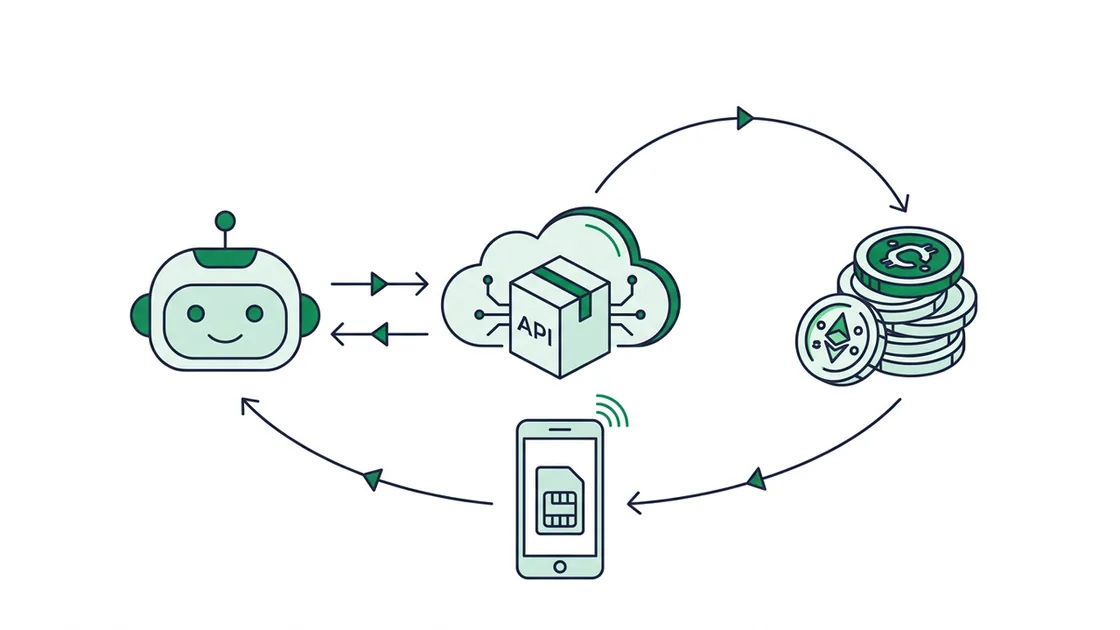
Autonomous AI agents fail on two fronts: their datacenter egress IPs get blocked or flagged, and most proxy vendors gate purchase behind a human checkout, an account, and a card. Proxy4G removes both. Every plan ships a genuine carrier IP via CGNAT with a 100% trust score, and the entire lifecycle — discover, quote, pay, provision — is callable over HTTP. An agent funds a USDC balance and completes a purchase through the 4G/5G inventory using the x402 protocol (scheme exact, USDC on Base), then connects over HTTP, HTTPS, or SOCKS5 in minutes.
Why do AI agents need mobile proxies instead of datacenter IPs?
Anti-bot systems score the network path before they ever look at behavior. A datacenter ASN is a near-instant flag; a residential or mobile ASN is not. Mobile proxies sit behind carrier-grade NAT (RFC 6598), so your agent shares an IP with thousands of legitimate phone users on the same carrier. Blocking that IP means blocking real customers, which carriers and platforms won't do — so mobile IPs carry a 100% trust score.
For agentic browsing — Playwright, Puppeteer, an LLM driving a headless Chromium, or a long-running scraping loop — this is the difference between a session that completes and one that hits a CAPTCHA wall on request three. Proxy4G IPs are real AT&T, T-Mobile, Verizon, EE, Three, Orange, Free Mobile, Jio 5G and Vodafone connections, not emulated. See mobile vs residential vs datacenter for the full trade-off.
Built for autonomous workloads
How does the x402 autonomous purchase flow work?
x402 turns HTTP 402 Payment Required into a real handshake. An agent doesn't need an interactive checkout — it gets a machine-readable price quote and pays inline with a signed stablecoin authorization. The Proxy4G flow is four steps:
- Account token —
POST /agent-api.php?action=accountreturns a Bearer token (no human registration; the account is created on first call). - Quote —
POST /agent-api.php?action=topupwith headerX-Payment-Mode: x402returns HTTP 402 plus anacceptsblock describing the payment: schemeexact, USDC on Base, the amount, and the pay-to address. - Sign — the agent signs an EIP-3009 USDC transfer authorization for that exact amount.
- Settle — re-send the same request with the signed payload in the
X-PAYMENTheader; the balance funds and the order provisions. Credentials (HOST, PORT, user, pass) arrive within minutes.
Discovery is standardized too: /mcp, /.well-known/agent.json, /openapi.json, and /llms.txt let an agent learn the API surface before it spends anything.
The x402 purchase sequence (curl)
# 1) Get a Bearer token — no signup, no KYC
TOKEN=$(curl -s -X POST "https://proxy4g.co/agent-api.php?action=account" | jq -r .token)

# 2) Ask to top up the balance over x402 -> server replies 402 + accepts block
curl -s -X POST "https://proxy4g.co/agent-api.php?action=topup" \
  -H "Authorization: Bearer $TOKEN" \
  -H "X-Payment-Mode: x402" \
  -d '{"amount_usdc":"30.00"}'
# -> HTTP/1.1 402 Payment Required
# {"accepts":[{"scheme":"exact","network":"base","asset":"USDC",
#              "maxAmountRequired":"30000000","payTo":"0x..."}]}

# 3) Sign an EIP-3009 USDC authorization for the exact amount (client-side),
#    then 4) re-send with the signed payload in X-PAYMENT:
curl -s -X POST "https://proxy4g.co/agent-api.php?action=topup" \
  -H "Authorization: Bearer $TOKEN" \
  -H "X-Payment-Mode: x402" \
  -H "X-PAYMENT: <base64-signed-eip3009-authorization>" \
  -d '{"amount_usdc":"30.00"}'
# -> 200 OK, balance funded. Order a proxy from the funded balance;
#    HOST:PORT + user:pass are emailed within minutes.
Using the proxy from your agent (Python)
import requests

# Credentials emailed after provisioning (placeholders shown):
HOST, PORT, USER, PASS = "HOST", "PORT", "USER", "PASS"
proxy = f"http://{USER}:{PASS}@{HOST}:{PORT}"
proxies = {"http": proxy, "https": proxy}

# Confirm you are exiting on the carrier IP, not your agent's host:
ip = requests.get("https://api.ipify.org", proxies=proxies, timeout=30).text
print("egress IP:", ip)

# Dedicated plans: rotate on demand by hitting your reset link
# requests.get(RESET_LINK)  # new carrier IP on the same port

# SOCKS5 (all plans) works too — install requests[socks]:
# socks = f"socks5h://{USER}:{PASS}@{HOST}:{PORT}"
# proxies = {"http": socks, "https": socks}
Dedicated or shared — which fits an agent fleet?
Pick by isolation and control. A dedicated proxy gives your agent an exclusive port and IP it can rotate on demand — instantly via the dashboard or a reset URL, or on an automatic timer from 1 to 60 minutes. That matters for stateful sessions: keep one IP for a logged-in flow, then cut to a fresh one between tasks. Dedicated starts at $27/mo.
A shared proxy is the budget tier — the IP auto-rotates every 5 minutes and is ideal for stateless, high-fan-out work like parallel web scraping or quick lookups where session pinning doesn't matter. Shared starts at $10.80/mo. Both tiers are real carrier IPs with HTTP, HTTPS, and SOCKS5; see rotating vs dedicated and full per-country rates on pricing. Durations run 1/3/6/12 months — longer terms lower the effective rate.
What makes Proxy4G agent-native
- x402 payment on the wire — agents pay with a signed USDC (Base) authorization, no human checkout
- No account, no KYC: no ID, name, address, phone, or email verification; the account is created on first call
- Crypto-only funding via x402 USDC plus a reusable wallet balance — see buy proxy with crypto
- Machine-readable discovery: /mcp, /.well-known/agent.json, /openapi.json, /llms.txt
- Real AT&T, T-Mobile, EE, Three, Orange and Jio 5G carrier IPs, not datacenter or emulated
- On-demand or 1–60 min rotation (dedicated) for clean session boundaries between agent tasks
- We do not log destination traffic
- HTTP / HTTPS / SOCKS5 with username:password or IP-whitelist auth
Frequently Asked Questions
x402 is a payment protocol that uses HTTP 402 Payment Required as a real handshake: the server returns an accepts block (scheme exact, USDC on Base), the client signs an EIP-3009 stablecoin authorization, and re-sends it in an X-PAYMENT header to settle. It lets an autonomous AI agent fund a balance and buy a proxy without a human checkout, card, or interactive flow — the purchase happens entirely over the API.
No. There is no government ID, name, address, phone, or email verification, and no card or bank data. An agent calls POST /agent-api.php?action=account to get a Bearer token; the account is auto-created on that first request. Funding is crypto-only — USDC over x402, or BTC, ETH, XMR and USDT to a wallet balance.
Proxy4G publishes machine-readable discovery endpoints: /mcp for the Model Context Protocol surface, plus /.well-known/agent.json, /openapi.json, and /llms.txt. An agent can read these to learn the available actions, parameters, and the x402 payment requirements before it ever signs an authorization.
They remove the most common flag. Proxy4G IPs are genuine carrier IPs behind CGNAT, so the destination sees a residential-grade mobile device sharing an ASN with thousands of real subscribers — a 100% trust score, unlike a datacenter IP. No proxy guarantees zero CAPTCHAs (behavior and fingerprint still matter), but a clean carrier IP is the foundation that lets the rest of your automation work.
Yes. On a dedicated plan the agent can rotate on demand — instantly via the dashboard or a reset URL — or set automatic rotation on a timer from 1 to 60 minutes, giving clean IP boundaries between tasks while keeping a session pinned when needed. Shared plans rotate automatically every 5 minutes, which suits stateless, high-throughput work.
All plans support HTTP, HTTPS, and SOCKS5, with username/password or IP-whitelist authentication. That covers requests, Playwright, Puppeteer, Selenium, and any tool that takes a proxy URL. Use socks5h:// when you want DNS resolved through the proxy. Credentials (HOST, PORT, user, pass) are emailed within minutes of payment.