


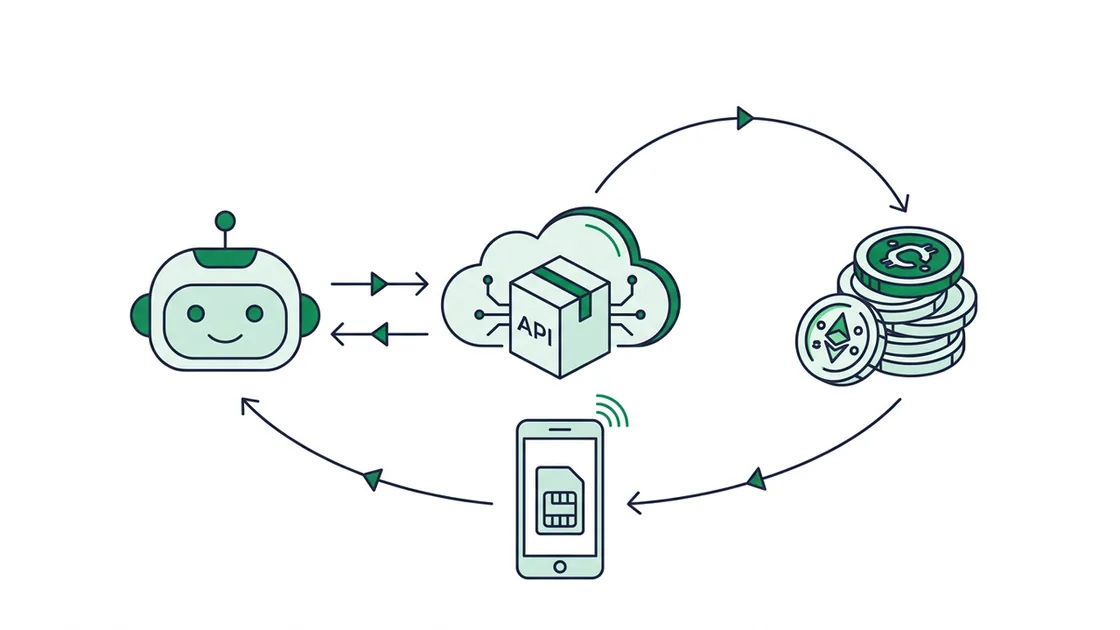
The agentic surface is a programmatic mirror of our human checkout: an agent reads a discovery file, creates an account to get a Bearer token, requests a balance top-up, receives an HTTP 402 with an accepts block, signs a USDC payment on Base, re-sends with an X-PAYMENT header, and then spends the funded balance on any of our 18 countries and 43 carriers. No card, no PayPal, no human approval step.
What is the x402 + MCP surface for?
x402 revives the dormant HTTP 402 Payment Required status code as a real payment handshake: an unauthenticated or unfunded request returns 402 plus a structured accepts block describing exactly how to pay, the agent pays, and re-sends the same request with proof. Proxy4G implements this for the one action that needs money — funding a wallet balance — so an autonomous agent can buy 4G mobile proxies end to end.
This is the same balance described in our crypto checkout: humans top up with Bitcoin, Ethereum, Monero or USDT, while agents top up with USDC on Base via x402. Once funded, the balance buys dedicated or SOCKS5 plans through the same order logic. If you are building autonomous infrastructure, see the AI agents and automation use case for runtime patterns.
The agentic surface at a glance
How does an agent discover the API?
Before transacting, an agent should fetch the machine-readable descriptors so it can plan the flow without scraping HTML. Three files are served at the site root:
- /.well-known/agent.json — the agent card: capabilities, the
/agent-api.phpbase, and the payment scheme (x402,exact, USDC on Base). - /openapi.json — the full OpenAPI definition of every action (
account,topup, order endpoints) with request/response shapes. - /llms.txt — a plain-text map of the site for language-model crawlers, with a companion /pricing.md for the per-country price table.
Discovery is read-only and unauthenticated, so an agent can decide whether and what to buy before it ever creates an account or moves funds.
The buying flow: configure → quote → pay → provision
- 1
Configure
The agent reads agent.json and pricing.md, then picks a plan from 18 countries / 43 carriers — e.g. a dedicated US T-Mobile 5G port, or a shared France Free Mobile IP that rotates every 5 minutes.
- 2
Account
POST /agent-api.php?action=account creates a no-KYC account on first call and returns a Bearer token. No name, address, phone or email verification is required.
- 3
Quote
POST /agent-api.php?action=topup with header X-Payment-Mode: x402 and no payment proof returns HTTP 402 plus an accepts block (scheme exact, asset USDC, network Base, amount, payTo address, nonce/validity).
- 4
Pay
The agent signs an EIP-3009 transferWithAuthorization for the quoted USDC amount to the payTo address on Base, producing a signed authorization payload.
- 5
Settle
Re-send the same topup request with the X-PAYMENT header carrying the signed authorization. On verification the balance is credited and the response returns 200.
- 6
Provision
The funded balance buys the chosen plan. Credentials (HOST, PORT, username, password) are emailed within minutes, and HTTP/HTTPS/SOCKS5 access is live with a 100% trust-score carrier IP.
Step 1 — create an account, get a Bearer token
curl -s -X POST 'https://proxy4g.co/agent-api.php?action=account' \
  -H 'Content-Type: application/json'

# 200 OK
# {
#   "account_id": "acct_...",
#   "token": "BEARER_TOKEN",
#   "balance_usdc": "0.00"
# }
Step 2 — request a top-up, receive the 402 quote
curl -s -i -X POST 'https://proxy4g.co/agent-api.php?action=topup' \
  -H 'Authorization: Bearer BEARER_TOKEN' \
  -H 'X-Payment-Mode: x402' \
  -H 'Content-Type: application/json' \
  -d '{"amount_usd": 27}'

# HTTP/1.1 402 Payment Required
# {
#   "x402Version": 1,
#   "accepts": [{
#     "scheme": "exact",
#     "network": "base",
#     "asset": "USDC",
#     "maxAmountRequired": "27000000",
#     "payTo": "0xYOUR_PAYTO_ADDRESS",
#     "resource": "/agent-api.php?action=topup",
#     "nonce": "0x...",
#     "validUntil": 1748505600
#   }]
# }
Step 3 — sign EIP-3009 and re-send with X-PAYMENT
# Sign an EIP-3009 transferWithAuthorization for the quoted USDC
# amount to payTo on Base, then base64 the payload into X-PAYMENT.

curl -s -X POST 'https://proxy4g.co/agent-api.php?action=topup' \
  -H 'Authorization: Bearer BEARER_TOKEN' \
  -H 'X-Payment-Mode: x402' \
  -H 'X-PAYMENT: <base64 signed authorization>' \
  -H 'Content-Type: application/json' \
  -d '{"amount_usd": 27}'

# 200 OK -> balance credited; spend it on any plan.
# Verify a provisioned proxy:
# curl -x http://USER:PASS@HOST:PORT https://api.ipify.orgWhat the agentic flow inherits from the human one
- No-KYC: no government ID, no name or address, no phone, no email verification — the account is auto-created on first call
- Real carrier IPs on physical SIMs across 18 countries and 43 carriers, 100% trust score
- Same plan logic: dedicated (rotate on demand or auto every 1–60 min) or shared (auto-rotate every 5 min)
- All three protocols: HTTP, HTTPS and SOCKS5, with username/password or IP-whitelist auth
- We do not log destination traffic — agentic purchases carry no extra telemetry
Build with the agentic surface
Frequently Asked Questions
x402 is a payment protocol built on the HTTP 402 Payment Required status code. A request that needs funds returns 402 with a structured accepts block describing how to pay; the client pays and re-sends the request with proof. Proxy4G uses it so autonomous agents can fund a balance with USDC on Base and buy mobile proxies with no human checkout step.
The scheme is exact, the asset is USDC, and settlement happens on the Base network. The agent signs an EIP-3009 transferWithAuthorization for the quoted amount to the payTo address returned in the 402 response, then re-sends the request with that signed authorization in the X-PAYMENT header.
No. The agentic flow inherits our no-KYC model: no government ID, no name or address, no phone, and no email verification. The account is created automatically on the first action=account call, and we do not log destination traffic.
Fetch the descriptors served at the site root: /.well-known/agent.json for the agent card and payment scheme, /openapi.json for the full action schemas, and /llms.txt plus /pricing.md for the site map and price table. All discovery is read-only and unauthenticated.
The same thing a human buyer gets: proxy credentials — host, port, username and password — emailed within minutes of the order. The proxy supports HTTP, HTTPS and SOCKS5, with username/password or IP-whitelist authentication, on a real carrier IP from one of 18 countries and 43 carriers.
Yes. The top-up credits a wallet balance, not a single order. Once funded with USDC on Base, an agent can place multiple orders against that balance — for example several dedicated ports across different countries — and top up again with another x402 cycle whenever the balance runs low.